
Weekly pool service from $149/mo — book online, no quote visit

Book now →
Warner Pools — Pool Service & Maintenance

— Deltona, FL · within 10 miles

Salt water pool service in Deltona, FLthe chemistry a salt cell cannot do for you

Weekly chemistry written for a salt pool, a visual check on the cell every visit, and a price confirmed before the first visit, month to month with no contract.

Book online · no quote visit

Get a price for salt water pool service

Takes about twenty seconds. We reply the same day.

Or call (386) 343-2446. No contract, cancel any time.

$149
Weekly service from
Per month, chemicals included
5
Readings every visit
Chlorine, pH, alkalinity, stabiliser, hardness
0
Contracts
Month to month, cancel any time
10 mi
Service radius
Around our Deltona base

— Salt Water Pool Service in Deltona

A salt water pool is a chlorine pool. The difference is where the chlorine comes from: instead of tablets or liquid, an electrolytic cell on the return line turns dissolved salt into chlorine as the water passes through. That is a real convenience. It is not a chemical-free pool, and it is not a pool that looks after itself. The cell handles one job, sanitiser, and leaves every other number to you.

Salt pools fail in their own way. The chlorine they make pushes pH upward week after week, high pH turns calcium into scale on the cell plates and the waterline, and scale is what shortens a cell's life. The Florida sun burns off chlorine the cell makes unless stabiliser is held in the right range, and the summer rain that fills the pool also dilutes the salt. None of this is hard to manage. It just has to be managed, every week, by someone who knows what a salt pool does.

That is this service, across Deltona, Enterprise and Stone Island, DeBary, Orange City, Lake Helen, Osteen, Sanford and Lake Mary. Below: why pH climbs, what stabiliser and salt level have to do with the sun and the rain, exactly what a weekly visit covers, what we look at on the cell and what we never touch, and what the service costs.

— Water chemistry

A salt water pool is a chlorine pool with its own generator

The most common misunderstanding we hear on a first visit is some version of "we went salt so we would not need chemicals." Here is what the system actually does and does not do.

What the cell does: it passes a low voltage across titanium plates, splitting dissolved salt into chlorine gas and sodium hydroxide. The chlorine dissolves instantly and sanitises exactly as tablet or liquid chlorine would, then returns to salt, which is why a salt pool only needs topping up after rain, splash-out or backwashing.

What the cell does not do:

  • It does not control pH. In fact it raises it, as the next section explains.
  • It does not add or protect stabiliser, so the chlorine it makes still burns off in the sun without cyanuric acid.
  • It does not manage alkalinity or calcium hardness, the two numbers that decide whether the water scales or etches.
  • It does not know what the actual chlorine level is. The output dial is a setting, not a measurement, and the right setting changes between a cold January week and a hot August one with a full pool.

So the weekly visit on a salt pool is the weekly visit on any pool, with the chemistry priorities rearranged and a cell to watch. Salt pools are easier to keep comfortable; they are not less work to keep balanced.
— Water chemistry

Why pH drifts up on a salt pool and what that does to the cell

Every salt pool we service shows the same tendency: left alone, pH climbs. Two reasons, both built into how the system works.

First, the cell produces sodium hydroxide alongside the chlorine. Sodium hydroxide is a base, and it nudges pH upward on every cycle the cell runs. Second, the hydrogen gas the cell releases comes out as fine bubbles at the returns, and that aeration drives off carbon dioxide, which also raises pH.

Rising pH matters because calcium becomes far less soluble as pH goes up. Two things happen:

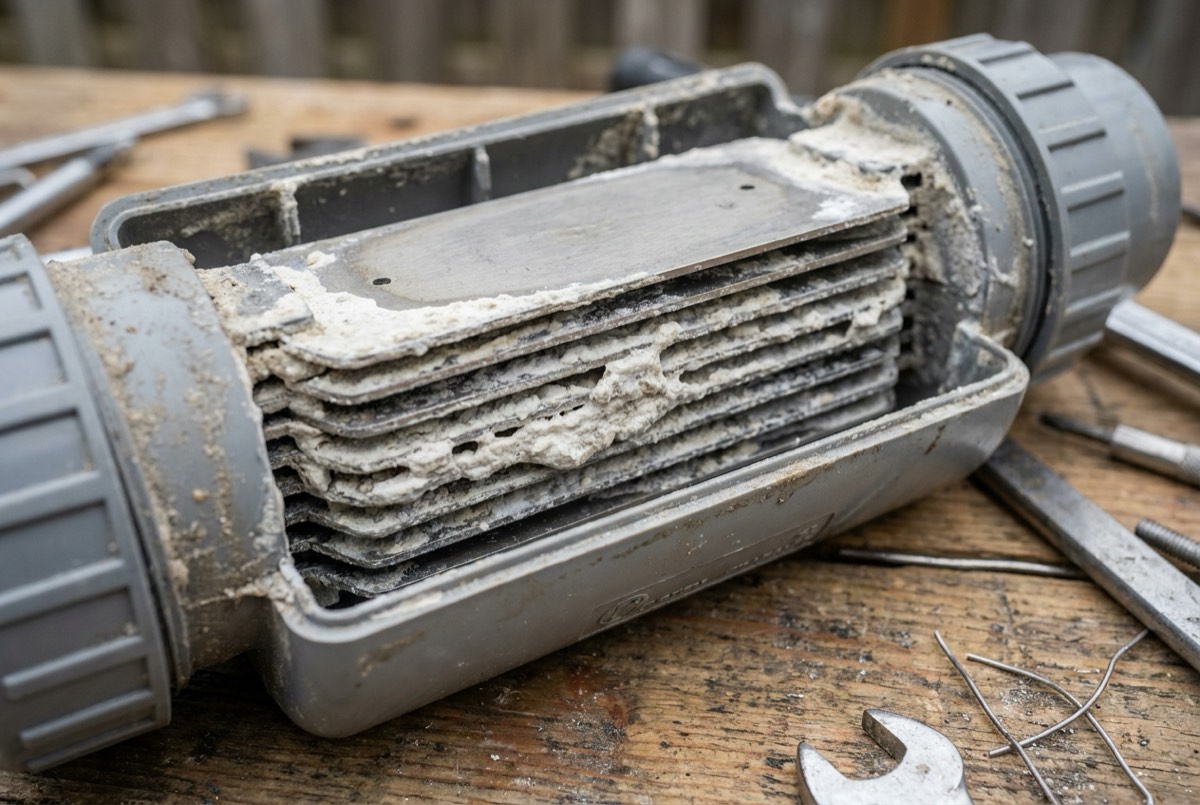
  • Scale on the cell plates. Calcium carbonate crystallises on the titanium plates and insulates them, so the cell works harder for the same chlorine. Scale is the leading reason cells wear out early, and it is a chemistry problem before it is an equipment problem.
  • Scale at the waterline. The same chemistry leaves the white band on the tile that brushing will not shift. The tile cleaning page covers removing it; this page is about not making it in the first place.

The answer is unglamorous: measured acid every week, holding pH at 7.4 to 7.6, with alkalinity set a little lower than on a tablet pool so pH is easier to hold down. Acid demand on a salt pool is usually higher than owners expect, not lower. We dose by the test, log the numbers and watch the trend, because the trend is what tells us the output or the aeration has changed.

— Same-day reply

Get a price for salt water pool service.

— Water chemistry

Stabiliser, salt level and the Florida sun

Two more numbers behave differently on a salt pool, and both are shaped by the weather here.

Stabiliser (cyanuric acid)

Cyanuric acid shields chlorine from ultraviolet light. Without it, the chlorine a cell makes in the morning is largely gone by mid-afternoon in a Florida summer, which is why most cell manufacturers specify a higher stabiliser range for salt pools than for tablet pools. The catch: stabiliser only leaves when water leaves the pool, so it creeps up if dosed casually, and at very high levels it locks the chlorine so it reads present but barely sanitises. We test it, hold it inside the range your unit calls for, and dose it deliberately rather than by habit.

Salt level

Salt does not evaporate, so the level only falls when water is lost: heavy afternoon rain pushing water out of the overflow from June through September, splash-out, and backwashing. It rises as water evaporates in the dry months. Both directions matter, because a cell outside its salt range makes less chlorine or stops. We carry a salt tester that does not rely on the unit's own reading, because a scaled or ageing cell misreports salt before it does anything else. When the two disagree, the independent reading is the one we trust.

A screened pool under a Deltona oak and an open pool on a lake in Sanford move these numbers at different rates, which is why they are tested weekly rather than assumed.

— Water chemistry

What a weekly salt water pool visit includes

Same day each week, the same person, and a photo of the water when we leave. On a salt pool the visit runs like this.

  1. Test first, before anything is added. Free and combined chlorine, pH, total alkalinity, calcium hardness, stabiliser and salt, from a sample taken away from the returns, logged.
  2. Read the unit. Output percentage, salt reading, any warnings, and whether the cell is actually cycling. A unit that says all is well is a data point, not a verdict.
  3. Balance. Acid to bring pH down and hold it, alkalinity adjusted, stabiliser or salt added only when the test says so and in the amount the pool volume calls for.
  4. Set the output. Turned up or down to match the season and the chlorine we are actually measuring, instead of one number all year.
  5. Brush, net, baskets. Walls, steps and waterline brushed, which matters more on a salt pool because scale starts as a film brushing can still move. Baskets emptied, floor vacuumed as needed.
  6. Filter pressure. Read against the clean baseline and backwashed when it calls for it. A teardown clean is its own job, described on the filter cleaning page.
  7. Visual check on the cell. Described in the next section.
  8. Photo and note. The water as we left it, and a line if anything needs your attention.

Chemicals are included in the weekly price, including the acid a salt pool goes through and the periodic salt and stabiliser top-ups.

— Water chemistry

Salt cell inspection: what we look at and what we do not touch

The cell is the one part of a salt pool where Florida law draws a firm line. Cleaning a pool and balancing its water needs no licence. Taking the cell out of the plumbing, acid-washing it or replacing it is work on permanently fitted water-treatment equipment, and that belongs with a licensed pool contractor. Our inspection is designed to be useful without crossing that line.

What the visual check covers, every visit:

  • The plates, viewed through the housing where it is clear, for white or grey crust building between them
  • Flow and the unit's own indicators: whether it reports flow, whether it is generating, and any warning lights or codes
  • The salt reading on the unit against our independent test
  • Whether chlorine production matches the output setting, the earliest sign a cell is losing capacity

What we do not do: we do not unplumb the cell, soak it in acid, replace it, or touch the control board or wiring. If the plates are scaling, we tell you with a photo and correct the chemistry that caused it. If the cell appears to be at the end of its life, we tell you that too, and replacement is identified and referred to a licensed pool contractor.

What you get is honest early warning. A cell caught scaling while the chemistry can still be corrected lasts longer than one discovered when the pool goes green, and the person telling you is not selling cells.

— Water chemistry

Salt water pool service in Lake Mary, Sanford, DeBary and across the route

Salt systems are most common on newer and higher-value pools, which shapes where we see them. Lake Mary has 5,909 pool homes and more than half of its single-family houses have a pool, the highest share on our route. Sanford has 4,276 pool homes, DeBary 2,613, and Deltona with Enterprise and Stone Island is our base; Orange City, Lake Helen and Osteen complete the ten-mile circle.

Two local facts matter more on a salt pool than on any other:

  • Hard fill water. Water across west Volusia and north Seminole comes out of limestone aquifer carrying calcium. Every top-up after evaporation adds hardness, and on a salt pool that calcium is already looking for a reason to come out of solution, so calcium hardness is tracked, not ignored.
  • Rain and sun in the same afternoon. Summer storms dilute salt and stabiliser and add debris; the sun before and after them burns chlorine. A salt pool here can swing from over-chlorinated to short in a week if the output is never adjusted. Weekly is the minimum that stays ahead of it.

The same scale pattern shows on the tile of almost every salt pool that has gone a season without pH control, which is why salt customers most often add a waterline tile clean at the start of service and then do not need another.

City pages: Lake Mary, Sanford, DeBary, Orange City, Lake Helen, Osteen, or the full service area.

— Cost & pricing

What salt water pool service costs and the terms

Salt water pool service is priced as weekly service. The weekly rate depends on pool size, whether it is screened, and how much tree cover it sits under; being a salt pool does not add a surcharge, and the acid, salt and stabiliser a salt pool uses are included. Current starting prices are on the pool cleaning cost page.

The terms are the part that should make the decision easy:

  • The price is confirmed before the first visit. Book online, tell us the pool, and we agree the number before anyone turns up. No quote visit, no surprise on the first invoice.
  • Month to month. No annual contract, no cancellation fee. If the service is not worth it to you, you stop it.
  • Chemicals included. Ask any other company quoting a salt pool whether acid is in the price or billed on top. On a salt pool that is not a small line.
  • A written log and a photo every week. You can see the pH trend and the salt reading yourself.
  • No equipment sales. We do not sell or replace cells, so our advice about yours has nothing riding on it.

If the pool is already green, start with a green pool recovery and move onto weekly service once the floor is visible. If you want the numbers written down and explained before deciding, book a water test. Otherwise, book weekly service and we will confirm your price.

Weekly pool service Deltona · West Volusia · Seminole

from $149 /mo

Chemicals included  ·  Same day every week  ·  No contract

Screened residential pool. Larger or shaded pools cost more; price confirmed before the first visit.

— Ready when you are

Salt Water Pool Service from a fixed weekly route.

— FAQ

Salt Water Pool Service questions, answered

Not answered here? Call — you get Dillion, not a call centre.

— Prefer to talk?(386) 343-2446Tap to call →
Do salt water pools still need chemicals?

Yes. The cell makes chlorine, but pH, alkalinity, stabiliser and calcium hardness all still have to be managed — and salt systems push pH up on their own, so acid demand is often higher than on a chlorine pool, not lower.

How often does a salt cell need attention?

Typically every three to six months in Central Florida, sooner if pH runs high — scale on the plates is what kills cells early. We check yours on every visit and tell you when it is scaling up. Removing and servicing a cell is licensed work in Florida, so that part goes to a licensed pool contractor; keeping the chemistry that causes the scale under control is ours.

Is a salt water pool cheaper to run than a chlorine pool?

Usually cheaper in chlorine and more expensive in acid, with a cell that eventually has to be replaced. Over the life of the cell the chemistry costs tend to come out closer than the sales pitch suggests. The real benefit is the water feel and steady chlorine between visits, not the running cost.

Why does my salt system say low salt when I just added salt?

Three common reasons: the salt has not fully dissolved and circulated yet, which can take a day; the water is cold, which makes many units under-read; or the cell is scaled or ageing and misreporting. We test salt independently of the unit so you know which it is before more salt goes in.

Can you convert my chlorine pool to salt?

No. Fitting a salt system is equipment work that requires a licensed pool contractor in Florida. Once it is in, we service the pool and its chemistry every week.

Why is there white scale on my tile if I have a salt pool?

Because salt pools run high pH unless someone holds it down, and high pH plus our hard fill water leaves calcium on the waterline as the pool evaporates. It is the same scale that builds on the cell plates, just where you can see it. Controlling pH stops it; a tile clean removes what is already there.

Do salt pools need to be shocked?

Sometimes. After heavy use, a storm, or a stretch of hot weather the cell cannot keep up on its own, and a measured dose of chlorine brings the pool back faster than running the unit on boost for days. We do it when the test calls for it, not on a schedule.

Does salt water damage the deck or the screen enclosure?

Pool salt levels are a fraction of seawater, but splash-out that dries repeatedly on natural stone, pavers or metal fittings can leave deposits and, over time, mark soft stone. A rinse with fresh water after heavy use is the simple answer. We will mention it if we see it starting.

Book online · no quote visit

Get the pool handled

Two minutes online and you pick the day. Or call and talk to Dillion.

Call (386) 343-2446 Book